
Protected Trust Deed
A calmer route towards a fresh financial start.
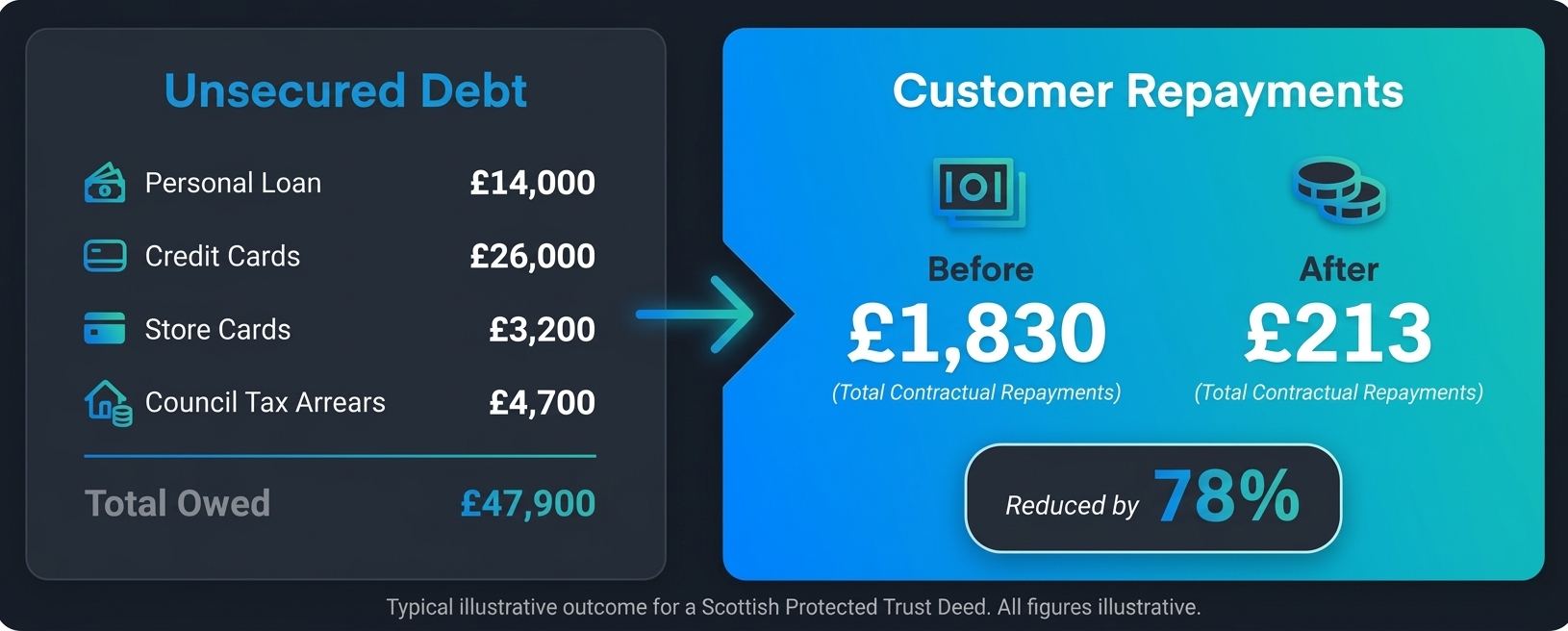
A Protected Trust Deed is a voluntary but legally binding debt agreement available only in Scotland — Scotland's equivalent of an IVA. You make affordable monthly payments for around four years, and whatever qualifying unsecured debt remains is written off.


Free debt counselling, debt adjusting and providing of credit information services is available to customers by contacting MoneyHelper.
Term
Around 4 years
Minimum debt
£6,000
Trustee
Licensed IP
Credit file
6 years
Who is it for?
You need to live in Scotland and owe at least £6,000 in unsecured debts. If you have a steady income and want a structured, manageable way out of serious debt, this is worth exploring.
What's included?
Most unsecured debts — credit cards, personal loans, payday loans, store cards, overdrafts, catalogue debt, utility bills and council tax arrears. Mortgages, secured car finance and hire purchase agreements are excluded.
How it works
From your first review to your final discharge, we guide you through every stage of the Scottish trust deed process.
Step 1
Initial Assessment
Comprehensive review of your finances.
Step 2
Preparation
We create a detailed proposal for creditors.
Step 3
Creditor Meeting
Creditors vote on the plan.
Step 4
Protection Gained
Your PTD is legally protected.
Step 5
Term
Make your affordable monthly payments.
Step 6
Debt Clearance
Remaining qualifying debt is written off.
Advantages
You are protected from legal action from creditors.
One, affordable monthly payment, allowing for all general living expenses & household bills.
Creditor contact will stop – your Trustee will liaise with your creditors, taking away the pressure of constant phone calls and distressing mail.
Interest, fees and charges are frozen from the date your Protected Trust Deed is signed.
A Protected Trust Deed does not involve court proceedings.
Your home and other assets can be retained, subject to value and circumstances – do not delay in taking advice if you have assets that you wish to protect.
If you are facing legal action, need help quickly and have chosen a Trust Deed as your debt solution then the Trust Deed can be signed immediately.
An earnings arrestment will cease to have effect on protection of the Trust Deed.
After successfully completing a Trust Deed, you will be discharged from all remaining debts and the balances will be written off.
Disadvantages
Your credit rating may be adversely affected.
Creditors may object to the Trust Deed proposal in sufficient number or value, causing it to fail to achieve protected status.
Granting a Trust Deed may result in you being refused credit, before or after your discharge is granted.
You may not be able to act as a Director of a limited company, unless the company’s articles of association allow you to do so.
Student loans are not discharged in a Trust Deed (or a Bankruptcy).
Equity in your property and/or other assets that you own may have to be realised for the benefit of your creditors, subject to value and your individual circumstances, do not hesitate to take advice if you have assets that you would like to protect.
Your Protected Trust Deed will be registered on the Register of Insolvencies, a publicly available online register of all insolvencies in Scotland.
Employment or future employment prospects may be affected by entering into a Trust Deed.
In a Trust Deed, the Trustee has claim on assets acquired for a period of 4 years from the date of signing the Trust Deed e.g. inheritance.
Quick check
Eligibility Check
Indicative only — no footprint left on your credit file.
See if a Trust Deed is the best option for you
We will compare a Protected Trust Deed against sequestration, the Debt Arrangement Scheme and the Minimal Asset Process before recommending anything.